

Call Support 24x7
+91 7559349467
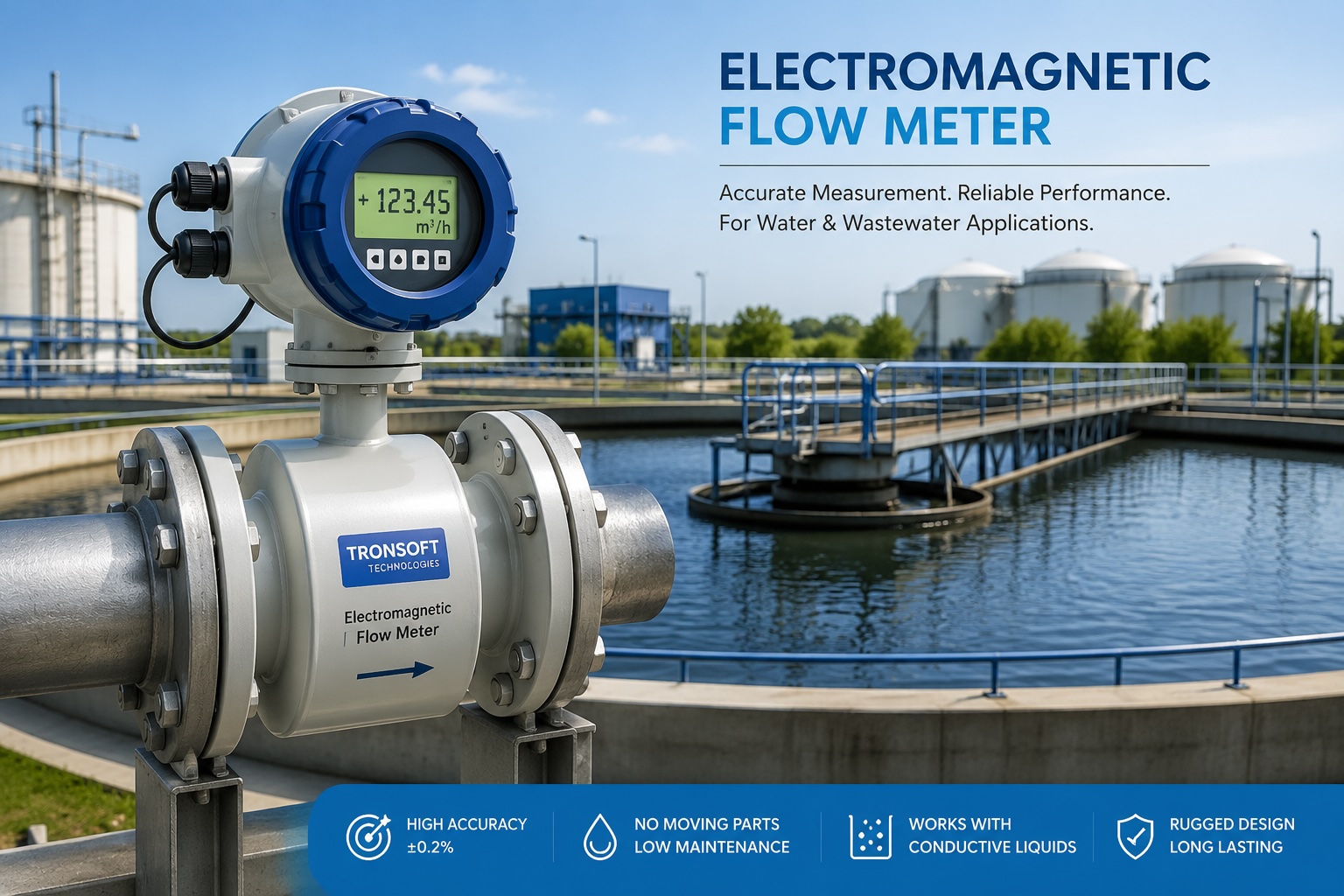
An electromagnetic flow meter (EMF or Magflow Meter) is one of the most accurate and reliable instruments for measuring the flow of conductive liquids. It is widely used in water treatment plants, wastewater treatment, chemical industries, pharmaceuticals, food processing, and process automation.
However, even the most advanced electromagnetic flow meter can produce inaccurate readings if one fundamental requirement is overlooked—the pipe must remain completely full during operation.
This article explains why maintaining a full pipe condition is essential and how proper flow meter sizing helps achieve accurate and stable measurements.
Electromagnetic flow meters operate based on Faraday's Law of Electromagnetic Induction. As a conductive liquid passes through a magnetic field generated inside the flow meter, it induces a voltage proportional to the fluid velocity.
The flow meter converts this voltage into a volumetric flow rate.
Since the electrodes measure the voltage generated by the liquid itself, the measuring tube must be completely filled with liquid. Any presence of air inside the measuring section directly affects measurement accuracy.
Electromagnetic flow meters assume that the measuring tube is 100% filled with liquid.
If the pipe is only partially full:
The electrodes may not remain fully submerged.
The induced voltage becomes unstable.
Flow readings fluctuate significantly.
Measurement accuracy deteriorates.
Maintaining a full pipe ensures consistent and repeatable measurements.
Air pockets inside the measuring tube often result in:
Erratic flow readings
Unexpected zero flow indication
Signal instability
Incorrect totalizer values
Many users mistakenly suspect instrument failure when the real issue is simply a partially filled pipe.
Most quality electromagnetic flow meters offer accuracy of:
±0.2%
±0.5%
These specifications are only achievable when installation guidelines—including full pipe conditions—are followed.
One of the biggest mistakes during selection is choosing a flow meter with the same nominal diameter as the pipeline without evaluating the actual flow rate.
Proper sizing should always be based on:
Minimum flow
Normal operating flow
Maximum flow
Desired fluid velocity
A correctly sized flow meter keeps the measuring tube full while maintaining an ideal velocity range.
For most water and wastewater applications:
| Flow Condition | Recommended Velocity |
|---|---|
| Minimum | 0.5 m/s |
| Normal | 1–3 m/s |
| Ideal | 2–3 m/s |
| Maximum | Up to 10 m/s (application dependent) |
Operating within this range improves:
Measurement accuracy
Electrode cleanliness
Signal stability
Long-term reliability
Suppose your pipeline is 150 mm, but the actual flow rate is relatively low.
Installing a 150 mm electromagnetic flow meter may result in:
Low fluid velocity
Partial pipe conditions during reduced flow
Poor accuracy
Sediment accumulation
Instead, using a 100 mm electromagnetic flow meter with concentric reducers can:
Increase liquid velocity
Keep the measuring tube full
Improve measurement accuracy
Reduce maintenance requirements
This approach is commonly recommended by experienced instrumentation engineers.
To maintain full pipe conditions:
Install the flow meter where the pipeline remains completely filled.
Avoid installation at the highest point of the pipeline.
Avoid installing immediately before a free discharge.
Prefer vertical upward flow whenever possible.
Maintain adequate straight pipe lengths as recommended by the manufacturer.
Eliminate air pockets using proper venting arrangements if necessary.
Following these guidelines significantly improves instrument performance and lifespan.
Ignoring full pipe requirements can lead to:
Unstable readings
Low measurement accuracy
False alarms
Incorrect billing data
Poor process control
Increased maintenance costs
Reduced customer confidence
Most flow measurement issues in the field are related to improper installation rather than instrument defects.
Before selecting a flow meter, evaluate:
Conductivity of the liquid
Minimum and maximum flow rates
Pipe size
Operating pressure
Temperature
Installation location
Required accuracy
Future process expansion
Proper engineering during selection prevents expensive operational issues later.
Selecting the correct electromagnetic flow meter is more than matching the pipeline diameter. The primary objective is to ensure that the measuring tube remains completely full under all operating conditions.
A properly sized flow meter delivers:
Higher measurement accuracy
Stable performance
Reduced maintenance
Longer service life
Improved process efficiency
If your application involves varying flow rates, consult an instrumentation expert before finalizing the meter size. In many cases, a carefully selected smaller meter with appropriate reducers provides significantly better performance than a full-line-size installation.
At Tronsoft Technologies, we help industries select the right electromagnetic flow meter based on actual process conditions—not just pipe size. Our team provides complete support for flow meter sizing, instrumentation selection, installation guidance, commissioning, and turnkey automation projects for water, wastewater, chemical, pharmaceutical, and industrial applications.
Contact us to ensure your next flow measurement solution delivers maximum accuracy and long-term reliability.
Contact Us
Feel Free To Get In Touch With Us
Office Address:
Karve road, near Garware metro stn, Pune | 411030 India
Follow Us:-
Looking For More?
Call Support 24x7
+91 7559349467